
SUBTITLE
TITLE
No Title
No Subtitle
-
SUBTITLE
TITLENo TitleNo Subtitlewww.iubilaeum2025.va
The JOURNEY Jubilee 2025 Edition is now available.
Learn about Jubilee, Indulgences, pilgrim churches in the Archdiocese, and upcoming pilgrimages.
SUBTITLE
TITLE
No Title
No Subtitle
-
SUBTITLE
TITLEDownload your Jubilee 2025 materials here:No Subtitle
SUBTITLE
TITLE
No Title
No Subtitle
-
SUBTITLE
TITLENo Subtitle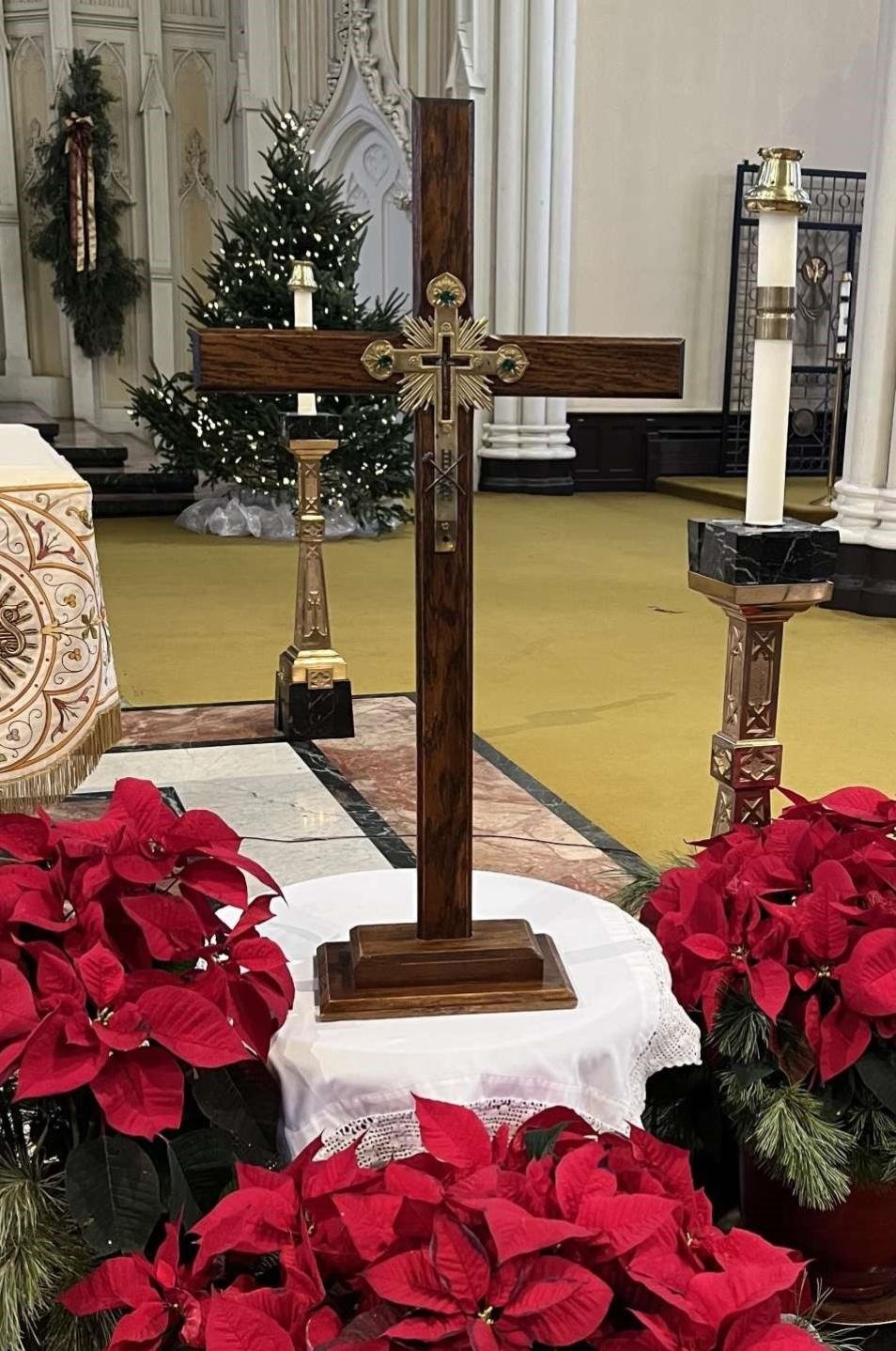 Reliquary with Wood of the Cross of Christ. My Dear Faithful of the Archdiocese,As we celebrate Our Lord Jesus Christ, King of the Universe, and begin a new liturgical year, the Archdiocese of Kingston prepares to begin to celebrate two important events. In 2025, at the invitation of Pope Francis, the Universal Church will celebrate a Jubilee Year. The last Jubilee was celebrated in 2000. Just as this year-long celebration ends, the Archdiocese will commemorate the 200th Anniversary of its foundation in 1826, which will last throughout the year and form a foundation for our apostolate for the coming decades.Our Holy Father has chosen the theme – “Pilgrims of Hope” – for the 2025 Jubilee Year. This theme will invite each of us to reflect upon and accept our identity as pilgrims. This pilgrimage is marked by hope rooted in Christ. Howimportantwill this foundation be! We know from our own experience how frustrating and often disappointing our hopes and initiatives are when they are rooted in ourselves. But with hope founded in Jesus. Christ and His grace, we allow ourselves to be precious instruments in the hand of the Lord.I pray that this time of the Jubilee Year will be a good introduction for the second important event,the 200th Anniversary of the Archdiocese in 2026. For this celebration, I have chosen a phrase from St. Paul’s letter to the Philippians-“To know Christ and the power of His resurrection.” As pilgrims of hope, strengthened in our true identity, our task in 2026 will be to deepen our knowledge and love of Christ. This invitation is open to each of the baptized, an invitation to deepen our personal relationship with the Risen Christ. Over the months ahead, consider how you may accept this invitation by participating in devotions and activities planned within your parish, local deanery, andthe broader Archdiocese. We rejoice that Jesus is a living reality in the Church and our lives. He desires that each soul He has created comes to know Him and live in intimate communion with Him,like the vine and the branches of St. John’s Gospel.I hope that the graces and fruits of 2025 will serve as a fitting introduction to our Anniversary celebrations in 2026. Let us pray that the Lord will bless our preparations, make holy our celebrations, and give His life-giving Spirit to our parishes now, and in future years as He has in the past.With prayerful best wishes for a holy and fruitful Advent Season, I remain,
Sincerely yours in Christ,
+Michael Mulhall
Archbishop of Kingston
PDF Download
The Jubilee began in Rome with the Opening of the Holy Door on Christmas Day, and then, on the Holy Family Sunday – December 29, 2024 the Jubilee opened in dioceses across the world. Archbishop Mulhall opened the Jubilee Year at St. Mary of the Immaculate Conception Cathedral at
10:30 am Holy Mass on December 29th, 2024. A special cross containing a reliquary with Wood of the Cross of Christ was processed to the Sanctuary.
-
SUBTITLE
TITLEWhat is a Jubilee or Holy Year?No SubtitleIn the Catholic tradition, a Holy Year, or Jubilee is a great religious event. It is a year of forgiveness, of reconciliation between adversaries, of conversion, and consequently of solidarity, hope, justice, commitment to serve God with joy and in peace with our brothers and sisters. A Jubilee year is above all the year of Christ, who brings life and grace to humanity.
Biblical Background:The origin of the Christian Jubilee goes back to Biblical times. The Law of Moses prescribed a special year for the Jewish people: “You shall hallow the fiftieth year and proclaim the liberty throughout the land, to all its inhabitants; it shall be a jubilee for you when each of you shall return to his property and each of you shall return to his family. This fiftieth year is to be a jubilee year for you…” (Leviticus 25, 10-13)
Catholic Background:At Christmas in 1299, during a time of plagues, suffering and wars, so many Christians traveled to Rome to pray at the tombs of the Apostles Peter and Paul, receive the Pope’s blessing, and obtain the strength to carry on, that Pope Boniface VII enquired about the reason for their coming. Admiring their faith he proclaimed 1300 a “year of forgiveness of all sins”. This was the first Holy Year or Jubilee. At first the Jubilee was held every 50 years, but, proving to be so popular, in 1470 Pope Paul II fixed the Jubilee for every twenty-five years.
Purpose of the Jubilee:The Jubilee is also called Holy Year because its purpose is to encourage and intensify a holy way of life. It is convoked to strengthen faith, encourage works of charity and communion within the Church and in society. It calls Christians to be more sincere and coherent in their faith in Christ, the only Saviour. Two traditional features of a Jubilee are a pilgrimage to Rome to pray at the tombs of Saints Peter and Paul and the opening of a Holy Door with the ability to obtain a plenary indulgence.
Theme of Jubilee 2025:In addition to calling the Church to renewed vigor through repentance and acts of faith, hope and charity, each Jubilee Year has a particular focus. Pope Francis has designated this Jubilee with its motto: Pilgrims of Hope. After the effects of the pandemic and unsettled condition throughout the world, he writes: “We must fan the flame of hope that has been given us, and help everyone to gain new strength and certainty by looking to the future with an open spirit, a trusting heart and far-sighted vision. … This will indeed be the case if we are capable of recovering a sense of universal fraternity and refuse to turn a blind eye to the tragedy of rampant poverty that prevents millions of men, women, young people and children from living in a manner worthy of our human dignity. Here I think in particular of the many refugees forced to abandon their native lands. May the voices of the poor be heard throughout this time of preparation for the Jubilee, which is meant to restore access to the fruits of the earth to everyone.” [Letter of Pope Francis]
The Jubilee will begin in Rome with the Opening of the Holy Door on Christmas Day, and then in the dioceses of the world, the Jubilee will begin on Holy Family Sunday, December 29, 2024.
Ways of Participating in the Jubilee and Gaining the IndulgenceThe main aim of the Jubilee is to assist us in drawing closer to Christ bys works of mercy and penance. This is a means of uniting ourselves to the sacrifice of Christ for the salvation of all people. This may be accomplished by a pilgrimage, an act of devotion or a work of mercy. The Decree establishing the Jubilee Year reads: “During the Ordinary Jubilee of 2025, all the faithful, who are truly repentant and free from any affection for sin, who are moved by a spirit of charity and who, during the Holy Year, purified through the sacrament of penance and refreshed by Holy Communion, pray for the intentions of the Supreme Pontiff, will be able to obtain from the treasury of the Church a plenary indulgence, with remission and forgiveness of all their sins, which can be applied in suffrage to the souls in Purgatory in the following ways:
A. Participating in a Pilgrimage
An essential element of the Jubilee is a pilgrimage. A pilgrimage reminds us that as a Church, we are on a journey in this life to our heavenly home. A pilgrimage is a journey with Christ to the Father. The pilgrimage may take several forms and offers the opportunity for gaining the Jubilee Indulgence. As part of the Pilgrimage, the individual must devoutly participate in the celebration of the Eucharist; or a celebration of the Word of God; or the Liturgy of the Hours; or a penitential celebration, which ends with the individual confessions of the penitents.1) To the Holy Door in Rome: By visiting one of the four Major Papal Basilicas: St. Peter’s in the Vatican, the Archbasilica of the Holy Saviour (St John Lateran’s), Saint Mary Major’s, and St. Paul’s Outside the Walls;2) To the Holy Land: By visiting at least one of the three basilicas: the Basilica of the Holy Sepulchre in Jerusalem, the Basilica of the Nativity in Bethlehem, or the Basilica of the Annunciation in Nazareth;3) To the Diocesan Cathedral: By visiting the Cathedral or other church or sacred place designated by the Bishop.B) Pious Visits to Sacred Places
Likewise, the faithful can obtain the Jubilee Indulgence if, individually or in a group, they devoutly visit any Jubilee church for a suitable period of time, engage in Eucharistic Adoration, concluding with the Our Father, the Profession of Faith (Creed), and invocations to Mary, the Mother of God, so that in this Holy Year everyone “will come to know the closeness of Mary, the most affectionate of mothers, who never abandons her children” (Spes non confundit, 24).C) Works of Mercy and Penance
The faithful will be able to obtain the Jubilee Indulgence if they visit, for an appropriate amount of time, their brothers and sisters who are in need or in difficulty (the sick, prisoners, lonely elderly people, disabled people…), in a sense making a pilgrimage to Christ present in them (cf. Mt 25, 34-36) according to the usual spiritual, sacramental and prayer conditions listed above.What is an Indulgence?
An indulgence is “the remission before God of the temporal punishment due for sins already forgiven as far as their guilt is concerned” (Canon Law, no. 992; Catechism of the Catholic Church, no. 1471). An indulgence is not to be confused with the forgiveness of sins. Sins are forgiven in the Sacrament of Reconciliation (Confession); however even after the forgiveness there remains a state of spiritual weakness, which is called “temporal punishment.” An indulgence is the healing of this temporal punishment, that is the spiritual weakness or inclination which sin has caused. As Pope Francis wrote: “Still, as we know from personal experience, every sin “leaves its mark”. Sin has consequences, not only outwardly in the effects of the wrong we do, but also inwardly, inasmuch as ‘every sin, even venial, entails an unhealthy attachment to creatures, which must be purified either here on earth, or after death, in the state called Purgatory’. [CCC, no. 1472] In our humanity, weak and attracted by evil, certain residual effects of sin remain. These are removed by the indulgence, always by the grace of Christ, who, as Saint Paul VI wrote, “is himself our ‘indulgence’”. [Apostolic Letter: Apostolorum Limina, 23 May 1974, II] For example, if a husband and wife have a major breakup. They may forgive each other, but the relationship needs healing and the restoration of trust before it can return to what it was before the breakup. An indulgence is this healing of the breakup and weakness that sin causes. It is accomplished by extra-ordinary acts. These are the making of a pilgrimage, giving alms, works of mercy, and practices of prayer and sacrifices as descrbed above.i.
How to Gain an Indulgence?
To obtain an indulgence, a) one must be in the state of grace; b) have complete detachment from sin, even venial sin; c) celebrate the Sacrament of Reconciliation (Confession of sins); d) receive the Holy Eucharist (Communion); e) pray for the intentions of the Pope; f) and perform the required charitable work, as listed above.
-
SUBTITLE
TITLECalendarNo Subtitle- There are no upcoming events.
-
SUBTITLE
TITLEThe Jubilee Prayer
No SubtitleFather in heaven,
may the faith you have given us
in your son, Jesus Christ, our brother,
and the flame of charity enkindled
in our hearts by the Holy Spirit,
reawaken in us the blessed hope
for the coming of your Kingdom.
May your grace transform us
into tireless cultivators of the seeds of the Gospel.
May those seeds transform from within both humanity and the whole cosmos
in the sure expectation
of a new heaven and a new earth,
when, with the powers of Evil vanquished,
your glory will shine eternally.
May the grace of the Jubilee
reawaken in us, Pilgrims of Hope,
a yearning for the treasures of heaven.
May that same grace spread
the joy and peace of our Redeemer
throughout the earth.
To you our God, eternally blessed,
be glory and praise for ever.
Amen.Official Hymn for the 2025 Jubilee
-
SUBTITLE
TITLEResourcesNo SubtitleCCCB Adult Faith Resources on the Jubilee Year 2025
Jubilee Activities for Families or Parish Groups
Explore the themes of the Jubilee Year with your family or fellow parishioners using the Jubilee activities created by the Canadian Council of Catholic Bishops. Adult faith resources for all Canadian Catholics to enter into prayerful participation in this Jubilee Year of Hope can be found on the Canadian Council of Catholic Bishops website. A series of activities have been developed for the six themes outlined in the Papal Bull, “Spes non Confundit”. They can be found here, CCCB Adult Faith Resources on the Jubilee Year 2025 – Canadian Conference of Catholic BishopsA group reflection and discussion guide are provided on each theme. The program is designed to take approximately 60 minutes for small groups to complete readings, and individual and group reflections, drawing deeper into the following Jubilee themes:
- A Universal Call to Jubilee: to be celebrated in Rome and worldwide
- Hope: Rooted in Baptism and enlivened by the Holy Spirit, faith, hope, love, and patience sustain us.
- A Journey of Hope: we are a pilgrim people
- Signs of Hope: the desire for peace and justice and the call to be signs of hope for the poor, imprisoned, sick, and dying.
- Appeals for Hope: ensuring the fruits of the earth are available to everyone, the forgiveness of debt, and celebrating the 1700th Anniversary of the Council of Nicea emphasizing our call to be synodal and to evangelize
- Anchored in Hope: the death and resurrection of Jesus, the witness of the Mother of God, the saints and martyrs, the gift of indulgences, and their importance.
-
SUBTITLE
TITLENo TitleNo Subtitle


Meet Luce, the official mascot for the Catholic Church’s 2025 Jubilee Year, together with her friends, Fe, Xin, and Sky, and her dog, Santino, and guardian angel.

Salt + Light Article on Luce
Learn about Luce’s design



SUBTITLE
TITLE
No Title
No Subtitle
-
SUBTITLE
TITLENo Subtitle
-
SUBTITLE
TITLENo TitleNo Subtitle
SUBTITLE
TITLE
No Title
No Subtitle
SUBTITLE
TITLE
No Title
No Subtitle