SUBTITLE
TITLE
No Subtitle
SUBTITLE
TITLE
No Title
No Subtitle
The Vallombrosan Congregation of the Order of Saint Benedict has its roots in the rich and ancient monastic tradition of the Church. Saint Benedict of Nursia (c. 480–547), often regarded as the Father of Western Monasticism, founded the famous monastery of Monte Cassino and gave the Church the Rule of Saint Benedict. For centuries, this Rule has inspired countless monks and monastic communities throughout the world, guiding them in a life of prayer, community, humility, work and service.
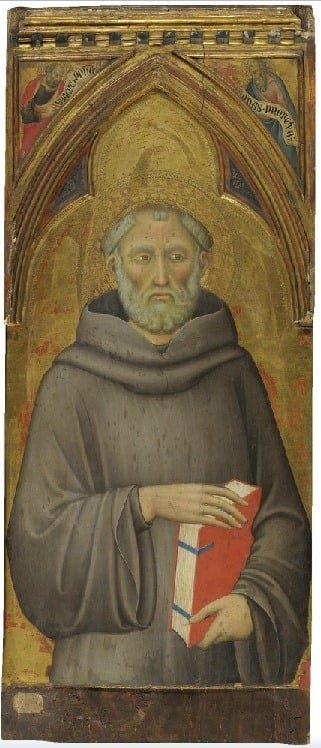
The Vallombrosan Congregation was founded by Saint John Gualbert (c. 985–1073) at Vallombrosa, near Florence in Italy. His mission was to renew monastic life by returning to the purity of the Gospel and to the authentic teachings of the Apostles, the Church Fathers and Saint Benedict. He placed particular emphasis on poverty, simplicity, manual labour and fidelity to the monastic vocation.
Saint John Gualbert worked passionately for the reform of monasteries and sought to restore a more authentic and evangelical way of life. Although he never wished to be ordained to the priesthood, nor even to receive Minor Orders, his love and respect for the priesthood were remarkable. He fought courageously against the abuses of simony, while strongly defending the dignity and importance of the priesthood. The early Vallombrosans also played an important role in the Church’s struggle against these abuses. One of the most famous events in their history was the ordeal by fire undertaken by Saint Peter Igneus in 1068, which became a powerful testimony to the reforming movement associated with Saint John Gualbert.
Saint John Gualbert was also widely known for his compassion towards priests and the poor. Several Popes held him in great esteem. Pope Leo IX travelled to Vallombrosa to meet him, while Pope Stephen IX and Pope Alexander II also greatly respected him. Pope Gregory VII praised the purity and meekness of his faith, recognising in him a remarkable example of compassion, goodness and fidelity to the Church.
Deeply rooted in the Rule of Saint Benedict, the Vallombrosan Benedictines give particular importance to community life, love for the priesthood, poverty, hospitality and service to the Church. Today, Vallombrosan monks are present in Italy, India and Brazil, and their spirituality continues to inspire people through their witness of prayer, fraternity and service. Their ideal may be beautifully expressed as ―Communion in Love‖—living together as brothers under the guidance of a superior, sharing their gifts and resources, supporting one another and serving God and humanity with love.
A branch of the Vallombrosan Benedictine Congregation was established in Kerala in 1988, within the Archdiocese of Kottayam and in the Eastern tradition of the Syro-Malabar Church. In 2016, the community was raised to the status of a sui iuris Priory, with its priory situated at Kaduthuruthy in Kottayam, Kerala. Today, around forty Vallombrosan monks serve in various monastic, pastoral, educational and social ministries in different parts of India. Their apostolate extends to the Oriental Churches, particularly the Syro-Malabar and Syro-Malankara Churches, as well as to the Latin Church.
Rooted firmly in community life, the monks seek to respond to the needs of society, especially through the social upliftment of the poor and the marginalized. They are also actively involved in ecumenism and interreligious dialogue, seeking to build bridges of understanding, fraternity and peace among people of different Christian traditions and religions.
Education is another important field of their apostolate. The Vallombrosan monks run two schools where children are welcomed irrespective of caste, creed or religion. Special attention is given to providing quality education and support to children from poor and disadvantaged backgrounds, thereby promoting the values of Benedictine education and human dignity. Following the Benedictine tradition of ora et labora—prayer and work, the Vallombrosan monks value manual labour as an essential expression of monastic life. Traditionally, monastic communities have supported their daily needs through activities such as farming, cheese-making and other forms of manual work. Through work, the monks recognise the dignity of human labour and share in the responsibility of building a self-sustaining community. Prayer and work are therefore not seen as separate realities, but as two complementary dimensions of a life dedicated to God.
The monks of St Mary’s sui iuris Priory of the Vallombrosan Benedictines at Kaduthuruthy have generously served the Church in India and beyond. Their ministry has extended to India, Italy and America, and, by the grace of God, their presence and service are now continuing in Canada as well.
Wherever they are sent, the Vallombrosan monks seek to remain faithful to their charism: rooted in the Rule of Saint Benedict, united in community, faithful to the Church, welcoming to all, and committed to serving God and humanity in love. The Vallombrosan tradition thus remains a living witness to the enduring relevance of Benedictine spirituality. In a world often marked by individualism, division and materialism, the Vallombrosan ideal of prayer, fraternity, simplicity, work, hospitality and communion in love continues to offer a meaningful and powerful message for the Church and for society. ―Communion in Love‖ is not merely an ideal, but a way of life— a life in which brothers journey together, seek God together, serve the Church together and extend the love of Christ to all.